

[Oct-2024] Feel HP HPE7-A01 Dumps PDF Will likely be The best Option
HPE7-A01 exam torrent HP study guide
The Aruba Certified Campus Access Professional exam is designed to test a wide range of skills and knowledge related to Aruba’s networking solutions. This includes in-depth knowledge of Aruba’s wireless technologies, such as access points, controllers, and management software. It also covers key concepts related to wired networking, such as VLANs, routing, and switching.
NEW QUESTION # 71
Select the Aruba stacking technology matching each option (Options may be used more than once or not at all.)
Answer:
Explanation:
NEW QUESTION # 72
A network administrator is troubleshooting some issues guest users are having when connecting and authenticating to the network The access switches are AOS-CX switches.
What command should the administrator use to examine information on which role the guest user has been assigned?
- A. diag-dump captiveportal client verbose
- B. show port-access captiveportal profile
- C. show aaa authentication port-access interface all client-status
- D. show port-access role
Answer: C
Explanation:
The show aaa authentication port-access interface all client-status command displays the status of all clients authenticated by port-based access control on all interfaces. The output includes the MAC address, user role, VLAN ID, and session timeout for each client. This command can be used to examine information on which role the guest user has been assigned by the AOS-CX switch.References:
https://techhub.hpe.com/eginfolib/Aruba/OS-CX_10.04/5200-6692/GUID-9B8F6E8F-9C7A-4F0D-AE7B-9D8E
NEW QUESTION # 73
Your customer has asked you to assign a switch management role for a new user The customer requires the user role to only have Web Ul access to the System > Log page and only have access to the GET method for REST API for the /logs/event resource Which default AOS-CX user role meets these requirements?
- A. sysops
- B. operators
- C. auditors
- D. administrators
Answer: C
Explanation:
The auditors role is the default AOS-CX user role that meets the requirements of having Web UI access to the System > Log page and having access to the GET method for REST API for the /logs/event resource. The auditors role has a level of 1 and allows read-only access to most commands except those related to security or passwords. It also allows access to the Web UI and REST API with limited permissions. The other options are incorrect because they either have higher levels of access or do not allow access to the Web UI or REST API.
References:
https://www.arubanetworks.com/techdocs/AOS-CX/10.04/HTML/5200-6728/bk01-ch01.html
https://www.arubanetworks.com/techdocs/AOS-CX/10.04/HTML/5200-6728/bk01-ch04.html
NEW QUESTION # 74
What is an Aruba-recommended best practice for hardening that only applies to Aruba CX 6300 series switches with dedicated management ports?
- A. Implement a control plane ACL to limit access to approved IPs and/or subnets
- B. Manually enable Enhanced Security Mode from a console session.
- C. Create a dedicated management VRF, and assign the management port to it.
- D. Disable all management services on the default VRF.
Answer: C
Explanation:
This is an Aruba-recommended best practice for hardening that only applies to Aruba CX 6300 series switches with dedicated management ports. A dedicated management port is a physical port that is used exclusively for out-of-band management access to the switch. A dedicated management VRF is a virtual routing and forwarding instance that isolates the management traffic from other traffic on the switch. By creating a dedicated management VRF and assigning the management port to it, the administrator can enhance the security and performance of the management access to the switch. The other options are incorrect because they either do not apply to switches with dedicated management ports or do not follow Aruba-recommended best practices.
NEW QUESTION # 75
A customer wants to enable wired authentication across all their CX switches One of the requirements is that the switch must be able to authenticate a single computer connected through a VoIP phone.
Which feature should be enabled to support this requirement?
- A. Multi-Domain Authentication
- B. Device-Based Mode
- C. Multi-Auth Mode
- D. MAC Authentication
Answer: A
Explanation:
Multi-Domain Authentication is the feature that should be enabled to support the requirement that the switch must be able to authenticate a single computer connected through a VoIP phone. Multi-Domain Authentication is a feature that allows an Aruba CX switch to apply different authentication methods and policies to different devices connected to the same port. For example, a VoIP phone and a computer can be connected to the same port using a single cable, but they can be authenticated separately using different credentials and assigned to different VLANs. The other options are incorrect because they either do not support multiple devices on the same port or do not provide authentication.
References:
https://www.arubanetworks.com/techdocs/AOS-CX/10.05/HTML/5200-7540/GUID-7D9E9F6E-5C2A-
4F7E-BE
https://www.arubanetworks.com/assets/tg/TB_ArubaCX_Switching.pdf
NEW QUESTION # 76
When configuring UBT on a switch what will happen when a gateway role is not specified?
- A. The switch will put the client on the access VLAN
- B. The gateway will send back the deny role to the client.
- C. The switch will assign the default deny role to the client.
- D. The gateway will assign a default role to the client
Answer: A
Explanation:
According to the Aruba Documentation Portal1, user-based tunneling (UBT) is a feature that uses GRE to tunnel ingress traffic on a switch interface to a gateway for further processing. UBT enables a switch to provide a centralized security policy, using per-user authentication and access control to ensure consistent access and permissions.
Option A: The switch will put the client on the access VLAN
This is because option A shows how UBT works on an Aruba switch. When a device connects to the network, it is authenticated using either MAC Authentication or 802.1X and triggers an enforcement policy from ClearPass, which contains an enforcement profile with a user role configuration. The user role can be assigned locally on the switch or on ClearPass as part of an enforcement profile. The user role determines the VLAN that the device belongs to and the access policies that apply to it23.
Therefore, option A is correct.
1: https://www.arubanetworks.com/techdocs/central/latest/content/nms/aos-cx/cfg/conf-cx-ubt.htm 2:
https://www.arubanetworks.com/techdocs/AOS-CX/10.06/HTML/5200-7696/GUID-581D2976-694B-46C7-849
https://community.arubanetworks.com/viewdocument/?DocumentKey=c740df4e-3e26-4cc5-9126-355a18709c4
NEW QUESTION # 77
Due to a shipping error, five (5) Aruba AP-515S and one (1) Aruba CX 6300 were sent directly to your new branch office You have configured a new group persona for the new branch office devices in Central, but you do not know their MAC addresses or serial numbers The office manager is instructed via text message on their smartphone to onboard all the new hardware into Aruba Central What application must the office manager use on their phone to complete this task?
- A. Aruba Onboard App
- B. Aruba CX Mobile App
- C. Aruba installer App
- D. Aruba Central App
Answer: C
Explanation:
Explanation
Aruba Installer App is a mobile app that simplifies site installations and enables network connectivity for Aruba devices. The app allows the user to scan the barcode of the device and add it to the network using Aruba Central. The app also automates importing Aruba devices into Aruba NetEdit for intelligent configuration management and continuous conformance validation
NEW QUESTION # 78
With the Aruba CX switch configuration, what is the first-hop protocol feature that is used for VSX L3 gateway as per Aruba recommendation?
- A. Active-Active VRRP
- B. SVI with vsx-sync
- C. VRRP
- D. Active Gateway
Answer: D
Explanation:
Active Gateway is the first-hop protocol feature that is used for VSX L3 gateway as per Aruba recommendation. Active Gateway is a feature that allows both VSX peers to act as active gateways for different subnets, eliminating the need for VRRP or other first-hop redundancy protocols. Active Gateway also provides fast failover and load balancing for L3 traffic across the VSX peers. The other options are incorrect because they are either not recommended or not supported by Aruba CX VSX. Reference: https://www.arubanetworks.com/techdocs/AOS-CX/10.04/HTML/5200-6728/bk01-ch07.html https://www.arubanetworks.com/resource/aruba-virtual-switching-extension-vsx/
NEW QUESTION # 79
Your Director of Security asks you to assign AOS-CX switch management roles to new employees based on their specific job requirements. After the configuration was complete, it was noted that a user assigned with the administrators role did not have the appropriate level of access on the switch. The user was not limited to viewing nonsensitive configuration information and a level of 1 was not assigned to their role.
Which default management role should have been assigned for the user?
- A. sysadmin
- B. operators
- C. helpdesk
- D. config
Answer: C
Explanation:
The helpdesk role is the default management role that should have been assigned for the user who needs to view nonsensitive configuration information. The helpdesk role has a level of 1 and allows read-only access to most commands except those related to security or passwords. The administrators role has a level of 15 and allows full read-write access to all commands. The operators role has a level of 5 and allows read-write access to most commands except those related to security or passwords. The config role has a level of 10 and allows read-write access to all commands except those related to security or passwords.
NEW QUESTION # 80
In ArubaOS-CX, which command enables the exporting of sFlow samples to an external collector?
- A. flow export
- B. mirror session
- C. sflow collector
- D. sflow enable
Answer: C
NEW QUESTION # 81
You are doing tests in your lab and with the following equipment specifications
* AP1 has a radio that generates a 10 dBm signal
* AP2 has a radio that generates a 11 dBm signal
* AP1 has an antenna with a gain of 9 dBi
* AP2 has an antenna with a gain of 12 dBi.
* The antenna cable for AP1 has a 2 dB loss
* The antenna cable for AP2 has a 3 dB loss
What would be the calculated Equivalent Isotropic Radiated Power (EIRP) for APT?
- A. 26 dBm
- B. 17 dBm
- C. -12 dBm
- D. 30 dBm
Answer: B
Explanation:
The calculated Equivalent Isotropic Radiated Power (EIRP) for AP1 is 17 dBm.
EIRP is the measured radiated power of an antenna in a specific direction. It is equal to the input power to the antenna multiplied by the gain of the antenna. It can also take into account the losses in transmission line, connectors, and other components. The formula for EIRP is:
EIRP = P + G - L
where P is the output power of the radio, G is the gain of the antenna, and L is the loss of the cable and connectors.
For AP1, we have:
P = 10 dBm G = 9 dBi L = 2 dB
Therefore,
EIRP = 10 + 9 - 2 EIRP = 17 dBm
NEW QUESTION # 82
Your customer is having connectivity issues with a newly-deployed Microbranch group The access points in this group are online in Aruba Central, but no VPN tunnels are forming.
What is the most likely cause of this issue?
- A. There is a time difference between the AP and the gateways The gateways should have NTP added
- B. The gateway group is running in automatic cluster mode and should be in manual cluster mode
- C. There may be a firewall blocking GRE tunneling between the AP and the gateway
- D. The SSL certificate on the gateway used to encrypt the connection has not been added to the APs trust list
Answer: C
Explanation:
Explanation
This is the most likely cause of the issue where the access points in a Microbranch group are online in Aruba Central, but no VPN tunnels are forming. A Microbranch group is a group that contains both APs and Gateways and allows them to form VPN tunnels for secure communication. The VPN tunnels use GRE (Generic Routing Encapsulation) as the encapsulation protocol and IPSec as the encryption protocol. If there is a firewall blocking GRE traffic between the AP and the gateway, the VPN tunnels cannot be established. The other options are incorrect because they either do not affect the VPN tunnel formation or do not apply to a Microbranch group. References:
https://www.arubanetworks.com/techdocs/ArubaOS_86_Web_Help/Content/arubaos-solutions/gateways/microb
https://www.arubanetworks.com/assets/tg/TB_ArubaGateway.pdf
NEW QUESTION # 83
Your Director of Security asks you to assign AOS-CX switch management roles to new employees based on their specific job requirements. After the configuration was complete, it was noted that a user assigned with the auditors role did not have the appropriate level of access on the switch.
The user was not allowed to perform firmware upgrades and a privilege level of 15 was not assigned to their role. Which default management role should have been assigned for the user?
- A. sysadmin
- B. sysops
- C. administrators
- D. config
Answer: B
Explanation:
The correct answer is B. sysops.
The sysops user role is a predefined role that allows users to perform system operations on the switch, such as backup, restore, upgrade, or reboot. The sysops user role also has access to the PUT and POST methods for REST API, which can be used to modify the switch configuration. The sysops user role has a privilege level of 15, which is the highest level of access on the switch1.
The other options are incorrect because:
A) sysadmin: The sysadmin user role is a predefined role that allows users to view and modify the switch configuration using the CLI or the Web UI. The sysadmin user role does not have access to the REST API methods, and cannot perform firmware upgrades1.
C) administrators: The administrators user role is a predefined role that has full access to all switch configuration information and all REST API methods. This role is more than what the Director of Security requires1.
D) config: The config user role is a predefined role that allows users to view and modify the switch configuration using the CLI or the Web UI. The config user role does not have access to the REST API methods, and cannot perform firmware upgrades1.
NEW QUESTION # 84
A customer has a site with 200 AP-515 access points 75AP-565 access points installed. The customer is rolling out new mobile phones with Wi-Fi-calling. 802.1X is in use for authentication What should be enabled to ensure the best roaming experience?
- A. 802.11W
- B. 802.1X
- C. 802 .11h
- D. 802. 11r
Answer: D
Explanation:
https://www.howtogeek.com/794724/what-is-wi-fi-calling/ 2:
https://www.networkcomputing.com/networking/your-network-optimized-wifi-calling 3:https://www.arubanetwo
NEW QUESTION # 85
Your Director of Security asks you to assign AOS-CX switch management roles to new employees based on their specific job requirements. After the configuration was complete, it was noted that a user assigned with the auditors role did not have the appropriate level of access on the switch.
The user was not allowed to perform firmware upgrades and a privilege level of 15 was not assigned to their role.
Which default management role should have been assigned for the user?
- A. administrators
- B. sysadmin
- C. sysops
- D. config
Answer: A
Explanation:
In AOS-CX switches, when assigning management roles to users that need to perform firmware upgrades and require a privilege level of 15, the role with the highest privileges should be chosen.
The "administrators" role typically provides full management access, including the ability to perform firmware upgrades and configure the switch. This role is suitable for users who need to perform advanced management and configuration tasks.
Other roles such as "sysadmin", "sysops", and "config" may provide certain levels of access but may not necessarily include the ability to perform firmware upgrades or have privilege level 15.
NEW QUESTION # 86
The administrator notices that wired guest users that have exceeded their bandwidth limit are not being disconnected Access Tracker in ClearPass indicates a disconnect CoA message is being sent to the AOS-CX switch.
An administrator has performed the following configuration
What is the most likely cause of this issue?
- A. The SSL certificate for CPPM has not been added as a trust point on the switch
- B. There is a time difference between the switch and the ClearPass Policy Manager
- C. There is a mismatch between the RADIUS secret on the switch and CPPM.
- D. Change of Authorization has not been globally enabled on the switch
Answer: D
Explanation:
Explanation
Change of Authorization (CoA) is a feature that allows ClearPass Policy Manager (CPPM) to send messages to network devices such as switches to change the authorization state of a user session. CoA requires that both CPPM and the network device support this feature and have it enabled. For AOS-CX switches, CoA must be globally enabled using the command radius-server coa enable. If CoA is not enabled on the switch, the disconnect CoA message from CPPM will be ignored and the user session will not be terminated. References:
https://www.arubanetworks.com/techdocs/ClearPass/6.7/PolicyManager/index.htm#CPPM_UserGuide/Admin/C
https://techhub.hpe.com/eginfolib/Aruba/OS-CX_10.04/5200-6692/GUID-9B8F6E8F-9C7A-4F0D-AE7B-9D8E
NEW QUESTION # 87
Match the terms below to their characteristics (Options may be used more than once or not at all.)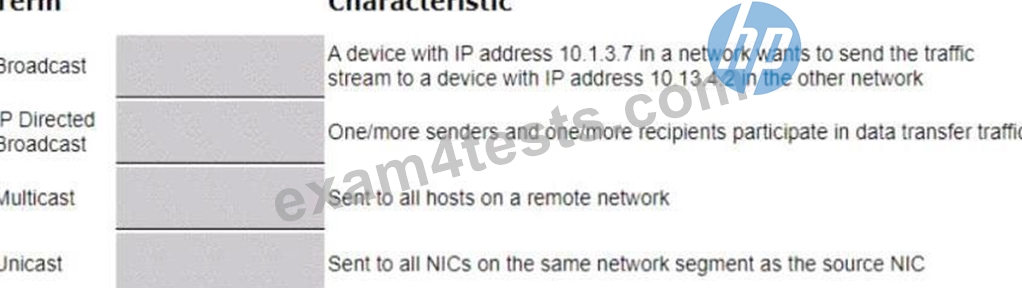
Answer:
Explanation: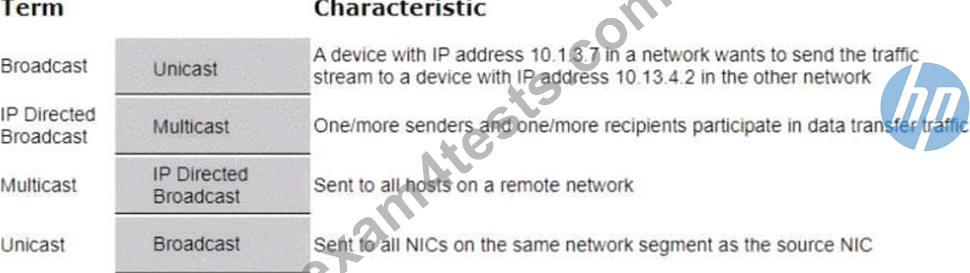
Explanation:
a) A device with IP address 10.1.3.7 in a network wants to send the traffic stream to a device with IP address 10.13.4.2 in the other network -> Unicast
b) One/more senders and one/more recipients participate in data transfer traffic -> Multicast
c) Sent to all hosts on a remote network -> IP Directed Broadcast
d) Sent to all NICs on the same network segment as the source NIC -> Broadcast References:
1 https://www.thestudygenius.com/unicast-broadcast-multicast/
The terms broadcast, IP directed broadcast, multicast, and unicast are different types of communication or data transmission over a network. They differ in how many devices are involved in the communication and how they address the messages.
The following table summarizes the characteristics of each term1:
A screenshot of a computer Description automatically generated with medium confidence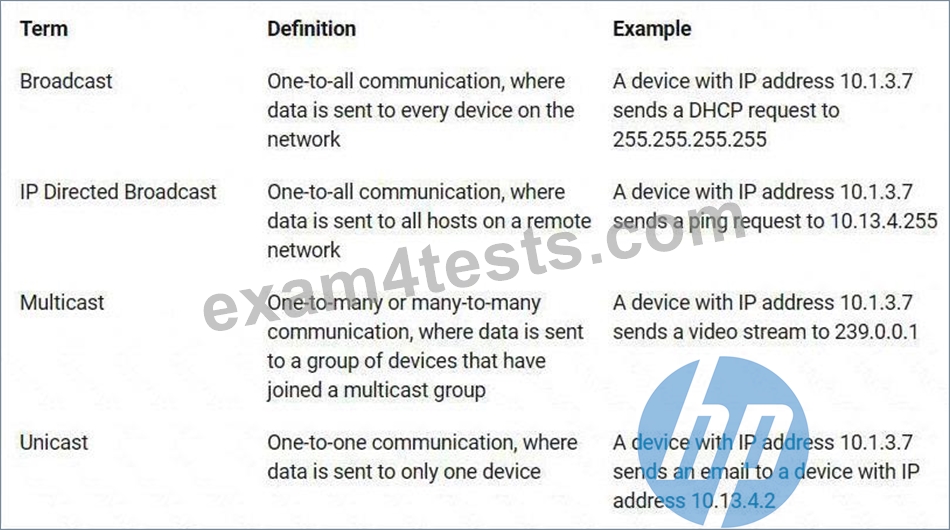
NEW QUESTION # 88
You need to drop excessive broadcast traffic on an ingress port or an ArubaOS-CX switch. What is the best feature to use for this task?
- A. DWRR queuing
- B. Strict queuing
- C. Rate limiting
- D. QoS shaping
Answer: C
Explanation:
According to the Aruba Documentation Portal1, the ArubaOS-CX switch supports various features to control the ingress traffic on specific ports, such as rate limiting, QoS shaping, and access control. These features can help reduce the impact of excessive broadcast traffic on the network performance and availability.
This is because rate limiting is a feature that allows you to limit the inbound or outbound traffic on a port based on a percentage of the port capacity or a fixed amount of bytes per second. Rate limiting can help prevent broadcast storms by reducing the amount of broadcast packets that enter or leave a port.
NEW QUESTION # 89
You are deploying a bonded 40 MHz wide channel.
What is the difference in the noise floor perceived by a client using this bonded channel as compared to an unbonded 20MHz wide channel?
- A. 4dB
- B. 3dB
- C. 2dB
- D. 8dB
Answer: B
Explanation:
The difference in the noise floor perceived by a client using a bonded 40 MHz wide channel as compared to an unbonded 20 MHz wide channel is 3 dB. The noise floor is the level of background noise in a given frequency band. When two adjacent channels are bonded, the noise floor increases by 3 dB because the bandwidth is doubled and more noise is captured. The other options are incorrect because they do not reflect the correct relationship between bandwidth and noise floor.
NEW QUESTION # 90
Two AOS-CX switches are configured with VSX at the the Access-Aggregation layer where servers attach to them An SVI interface is configured for VLAN 10 and serves as the default gateway for VLAN 10. The ISL link between the switches fails, but the keepalive interface functions. Active gateway has been configured on the VSX switches.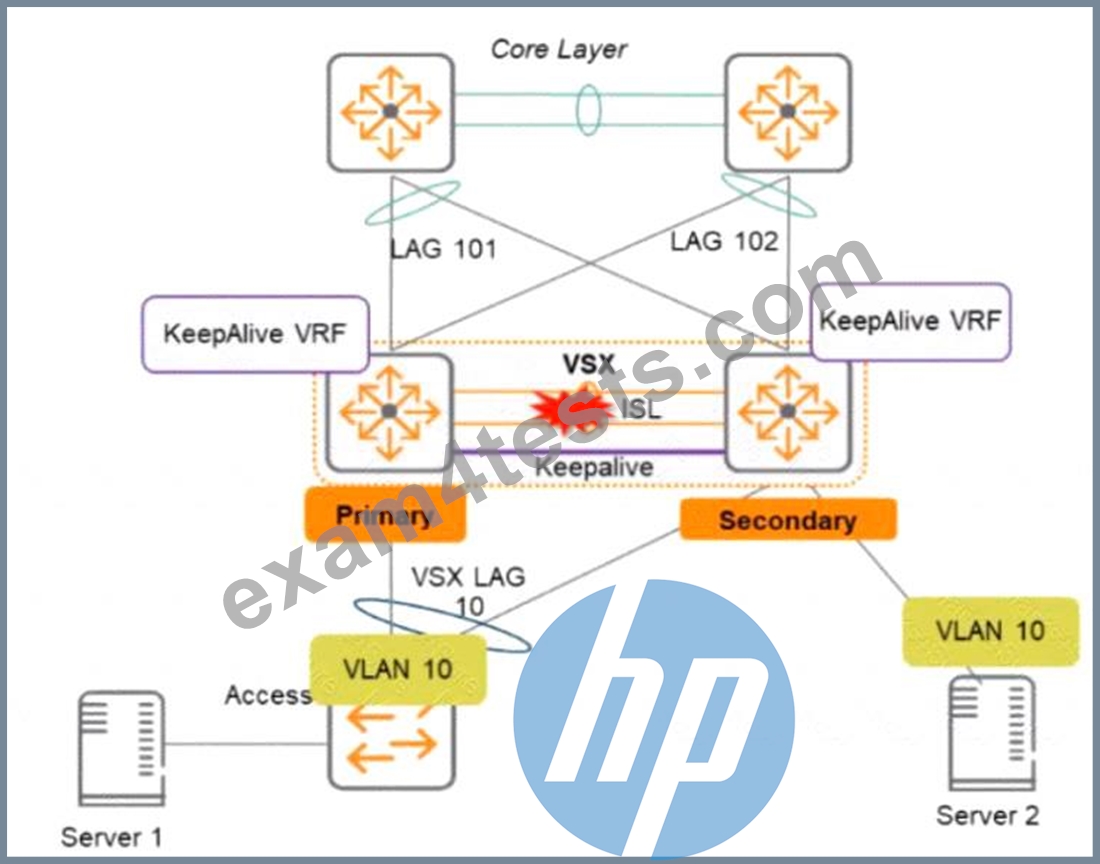
What is correct about access from the servers to the Core? (Select two.)
- A. Server 2 cannot access the core layer.
- B. Server 2 can access the core layer via the keepalive link
- C. Server 1 and Server 2 can communicate with each other via the core layer
- D. Server 1 can access the core layer via the keepalrve link
- E. Server 1 can access the core layer on only one uplink
- F. Server 1 can access the core layer via both uplinks
Answer: C,F
Explanation:
Explanation
These are the correct statements about access from the servers to the Core when the ISL link between the switches fails, but the keepalive interface functions. Server 1 can access the core layer via both uplinks because it is connected to VSX-A, which is still active for VLAN 10. Server 2 can also access the core layer via its uplink to VSX-B, which is still active for VLAN 10 because of Active Gateway feature. Server 1 and Server 2 can communicate with each other via the core layer because they are in the same VLAN and subnet, and their traffic can be routed through the core switches. The other statements are incorrect because they either describe scenarios that are not possible or not relevant to the question. References:
https://www.arubanetworks.com/techdocs/AOS-CX/10.04/HTML/5200-6728/bk01-
NEW QUESTION # 91
......
Use Valid New HPE7-A01 Test Notes & HPE7-A01 Valid Exam Guide: https://torrentpdf.exam4tests.com/HPE7-A01-pdf-braindumps.html