

[Aug-2026] Updated and Accurate UiPath-ADPv1 Questions & Answers for passing the exam Quickly
Download Real UiPath-ADPv1 Exam Dumps for candidates. 100% Free Dump Files
NEW QUESTION # 49
A developer aims to employ the REFramework for automating a business process that Involves a TransactionData collection (DataTable) comprising vendor names and addresses.
Instructions: Choose the appropriate variable type for the Transactionltem from the provided drop-down list in the following exhibit.

Answer:
Explanation:
Explanation:
The REFramework (Robotic Enterprise Framework) in UiPath is designed to work with transactional data.
For a process that involves iterating over a DataTable where each row represents a transaction item, the appropriate variable type for the TransactionItem would be a DataRow.
In the context of REFramework, a DataRow is typically used to represent a single transaction item when the transaction data is contained within a DataTable. This allows the framework to process each row (or transaction) one by one.
Therefore, the correct variable type for the TransactionItem from the drop-down list should be DataRow.
NEW QUESTION # 50
What is the purpose of the Interval filter in the Orchestrator's Monitoring page?
- A. It allows you to allocate licenses per machine for the displayed data.
- B. It enables you to sort the displayed data based on job priorities.
- C. It allows you to control the granularity of the displayed data and check the health of your system in either the last day or the last hour.
- D. It allows you to choose between background and foreground processes for the displayed data.
Answer: C
Explanation:
The purpose of the Interval filter in the Orchestrator's Monitoring page is to allow you to control the granularity of the displayed data and check the health of your system in either the last day or the last hour.
The Monitoring page provides various metrics and charts that show the status and performance of your robots, processes, queues, and transactions. The Interval filter lets you choose the time frame for the data that you want to see. You can select either the last day or the last hour as the interval. The data will be updated accordingly and show you the trends and changes in your system over the selected period. This can help you identify any issues or anomalies and take corrective actions if needed.
NEW QUESTION # 51
A developer plans to create a process to automate a web application using the Firefox browser. The goal Is to have the robot work with the web application without relying on visual elements on screen.
To achieve this goal, what option should the developer use for the Use Application/Browser activity?
- A. WebDriver mode = Headless
- B. User Data Folder Mode = CustomFolder
- C. Input mode = Chromium API
- D. Input mode = Simulate
Answer: D
Explanation:
To work with a web application in Firefox without relying on visual elements, the developer should use the ' Input mode = Chromium API ' . This option enables the robot to interact with the web elements directly, without the need for visual screen elements.
NEW QUESTION # 52
A developer implemented a process using the REFramework and an Orchestrator queue. The " OrchestratorQueueFolder " was defined in the " Config.xlsx " file, but the folder does not exist in Orchestrator What is the behavior at runtime?
- A. The process throws an exception in the " Get Transaction Data " state because the queue folder is not found, and then the process is stopped.
- B. The process throws an exception in the " Process Transaction" state because the queue folder is not found, and then the process is stopped.
- C. No exception is thrown and neither will a message be logged and the process continues.
- D. A warning message stating that the queue folder is missing is logged, and then the process continues.
Answer: A
Explanation:
The REFramework (Robotic Enterprise Framework) is a template that provides a standard structure and best practices for building automation projects using UiPath Studio1. It uses the State Machine workflow type to handle different scenarios and exceptions in a robust and scalable way2. One of the states in the REFramework is the Get Transaction Data state, which is responsible for fetching the next transaction item from the Orchestrator queue and assigning it to a variable3. The Orchestrator queue is a data structure that stores multiple items that need to be processed by the robots4. The queue can be organized into folders, which are logical containers that help group and manage the queues and other Orchestrator entities5.
If a developer implemented a process using the REFramework and an Orchestrator queue, they need to specify the name of the queue and the folder where it is located in the Config.xlsx file, which is an Excel workbook that stores the configuration settings and constants for the project6. The name of the queue should be entered in the Settings sheet, under the OrchestratorQueueName key, and the name ofthe folder should be entered in the Constants sheet, under the OrchestratorQueueFolder key6. These values are then read by the InitAllSettings workflow, which is invoked in the Init state of the REFramework, and assigned to the in_Config argument, which is a dictionary that holds all the configuration data7.
At runtime, the Get Transaction Data state invokes the GetTransactionData workflow, which takes the in_Config argument as an input and uses it to get the queue item from the Orchestrator queue8. The workflow uses the Get Queue Items activity, which requires the QueueName and FolderPath properties to be specified9. The QueueName property is set to in_Config("OrchestratorQueueName").ToString, and the FolderPath property is set to in_Config("OrchestratorQueueFolder").ToString8. If the folder specified in the Config.xlsx file does not exist in Orchestrator, the Get Queue Items activity will throw an exception with the message "Folder does not exist" and the process will be stopped10. Therefore, the correct answer is B. The process throws an exception in the "Get Transaction Data" state because the queue folder is not found, and then the process is stopped.
The other options are incorrect because:
* Option A is incorrect because the process will not continue if the queue folder is missing. The Get Queue Items activity will fail and the exception will be caught by the Try Catch block in the GetTransactionData workflow, which will set the out_TransactionItem argument to Nothing and the out_TransactionID argument to " No more data " 8. This will cause the transition condition from the Get Transaction Data state to the Process Transaction state to evaluate to False, and the transition condition from the Get Transaction Data state to the End Process state to evaluate to True3. The End Process state will invoke the SetTransactionStatus workflow, which will log the exception message and the process will be stopped11.
* Option C is incorrect because an exception will be thrown and a message will be logged if the queue folder is missing. The exception will be thrown by the Get Queue Items activity, as explained above, and the message will be logged by the SetTransactionStatus workflow, which uses the Log Message activity to write the exception message to the Output panel and the Orchestrator logs11.
* Option D is incorrect because the process will not reach the Process Transaction state if the queue folder is missing. The Process Transaction state is responsible for executing the business logic for each transaction item and invoking the SetTransactionStatus workflow to update the status of the item in the Orchestrator queue12. However, if the queue folder is missing, the Get Queue Items activity will throw an exception and the out_TransactionItem argument will be set to Nothing, which will prevent the transition from the Get Transaction Data state to the Process Transaction state83.
References:
Studio - Robotic Enterprise Framework Template - UiPath Documentation Portal Studio - State Machines - UiPath Documentation Portal Studio - REFramework - UiPath Documentation Portal Orchestrator - Queues - UiPath Documentation Portal Orchestrator - Folders - UiPath Documentation Portal Studio - Config File - UiPath Documentation Portal Studio - InitAllSettings - UiPath Documentation Portal Studio - GetTransactionData - UiPath Documentation Portal Activities - Get Queue Items - UiPath Documentation Portal Orchestrator - Troubleshooting - UiPath Documentation Portal Studio - SetTransactionStatus - UiPath Documentation Portal Studio - Process Transaction - UiPath Documentation Portal
NEW QUESTION # 53
What is the role of connections in the UiPath Integration Service?
- A. Connections establish tasks and exchanges between users and external applications using the authentication process of the API provider.
- B. Connections establish tasks and exchanges based on a connector's compatibility with the external application.
- C. Connections establish tasks and exchanges between users and external applications using the server-side triggers.
- D. Connections establish tasks and exchanges between users and external applications using the authentication process of the UI automation provider.
Answer: A
Explanation:
The UiPath Integration Service is a feature of Automation Cloud that allows you to connect to various external applications and systems using predefined connectors. A connector is a component that provides the logic and interface for interacting with a specific application or system. A connection is an instance of a connector that is configured with the credentials and parameters required to access the application or system.
The role of connections in the UiPath Integration Service is to establish tasks and exchanges between users and external applications using the authentication process of the API provider. An API provider is a service that exposes an application programming interface (API) for accessing and manipulating data and functionality of an application or system. For example, Microsoft Outlook 365, Salesforce, and Google Sheets are some of the API providers that have connectors in the UiPath Integration Service.
To create a connection, you need to select a connector and provide the authentication details for the API provider. The authentication process may vary depending on the type and security level of the API provider.
For example, some API providers may use OAuth 2.0, which is a standard protocol for authorizing access to resources on behalf of a user. Other API providers may use API keys, which are unique identifiers that are used to authenticate requests to the API.
Once you create a connection, you can use it to perform various tasks and exchanges with the external application or system. For example, you can use the Microsoft Outlook 365 connector to send and receive emails, create and update calendar events, and manage contacts. You can use the Salesforce connector to create and update records, execute queries, and invoke actions. You can use the Google Sheets connector to read and write data, format cells, and manage worksheets.
You can use the connections in your automation workflows in UiPath Studio, UiPath Apps, UiPath Assistant, and UiPath Test Suite. You can also manage and share your connections in UiPath Orchestrator, using the folder structure and permission system.
References: Integration Service - Introduction - UiPath Documentation Portal, Integration Service - Connections - UiPath Documentation Portal, New UiPath Integration Service | UiPath
NEW QUESTION # 54
What is the correct sequence of steps in a REFramework project that is linked to Orchestrator it an application exception occurs on a Queue Item m the Process Transaction stale?
Instructions: Drag the Description found on the "Left" and drop on the correct Step Sequence found on the Right".
Answer:
Explanation:
Explanation:
NEW QUESTION # 55
In UlPath Orchestrator. when managing multiple Jobs in a queue, which feature allows operators to dictate the execution sequence by assigning the importance of each Job?
- A. Job Execution Order
- B. Job Queuing Strategy
- C. Jab Dependency Settings
- D. Job Priority Levels
Answer: D
Explanation:
In UiPath Orchestrator, the Job Priority Levels feature allows operators to assign priority to jobs in a queue, thereby dictating their execution sequence based on their importance.
NEW QUESTION # 56
When encountering an ApplicationException, what occurs if the developer chooses InvalidOperationException as the exception handler within the Catches section of the Try Catch activity?
- A. No exception is thrown and the Finally block executes.
- B. A runtime error occurs and the Finally block is not executed.
- C. No exceptions are happening and the workflow continues to execute.
- D. The Finally block is executed and the Catches section catches the exception.
Answer: D
Explanation:
In a Try Catch activity within UiPath, when an exception is thrown that does not match any of the exception types specified in the Catches section, the exception is unhandled by the Catches section. If the thrown exception is an ApplicationException and the Catches section is only configured to handle an InvalidOperationException, then the ApplicationException is not caught because it is a different type of exception.
However, regardless of whether the exception is caught, the Finally block always executes. The Finally block is designed to run after the Try block and after any Catch blocks are checked for matches (regardless of whether a match is found or not).
Therefore, the correct answer is:
A:The Finally block is executed and the Catches section catches the exception.
In this context, "the Catches section catches the exception" means that the Catches section is evaluated for a match. Since ApplicationException is not handled by the InvalidOperationException catch block, the exception is not actually caught, but the Finally block will still execute.
NEW QUESTION # 57
What is the main function of the UiPath Remote Runtime component?
- A. It introduces support for headless browser automation, so browser automation doesn't necessarily have to rely on visual elements on screen, such as window frames.
- B. It allows automations to run on the user machine, in a different Windows session.
- C. It facilitates the communication between a remote application or desktop and the dedicated UiPath extension, allowing selectors to be natively generated in UiExplorer.
- D. It enables the use of OCR and image recognition activities on remote applications or desktops, without any extensions, allowing selectors to be natively generated in UiExplorer.
Answer: C
Explanation:
The UiPath Remote Runtime component is a component that facilitates the communication between a remote application or desktop, such as Citrix Virtual Apps, and the dedicated UiPath extension - the UiPath Extension for Citrix, the UiPath Extension for Windows Remote Desktop and Apps, or the UiPath Extension for VMware Horizon1. It gathers information about the targeted UI elements of the remote applications and sends them to the corresponding extension, so that selectors are natively generated in UiExplorer1. The UiPath Remote Runtime component is required to establish the connection between an application or desktop server and a corresponding UiPath extension installed on a client machine, where Studio is installed1. This way, selectors are natively generated on the client machine, without having to rely on OCR and image recognition activities1. .
NEW QUESTION # 58
When a developer runs a process using the REFramework, with the process utilizing Orchestrator queues and a queue already created with the Name provided and the Auto Retry function disabled, which states will be executed without errors?
- A. Initialization -> Process Transaction -> End Process
- B. Initialization -> Get Transaction Data -> End Process
- C. Initialization -> Get Transaction Data -> Process Transaction -> End Process
- D. Initialization -> End Process
Answer: C
NEW QUESTION # 59
What role do Triggers play in the UiPath Integration Service?
- A. Provide a mechanism for subscribing to specific events from third-party applications, automatically starting processes in Orchestrator.
- B. Provide a mechanism for starting processes on a scheduled basis from Orchestrator.
- C. Assist in the creation of automation projects by providing event-based activities.
- D. Manage connections between UiPath Studio and third-party applications.
Answer: A
NEW QUESTION # 60
What actions must be manually selected in the App/Web Recorder before recording a step?
- A. Copy text using the Get Text activity.
Hover over an element using the Hover activity.
Click on buttons, links, and other clickable elements such as icons or images.
Type text in a text area such as a text box.
Select or clear a check box. - B. Copy text using the Get Text activity.
Hover over an element using the Hover activity.
Highlight an element using the Highlight activity. - C. Select or clear a check box.
Send keyboard shortcuts using your keyboard.
Select an item from a drop-down. - D. Click on buttons, links, and other clickable elements such as icons or images.
Type text in a text area such as a text box.
Select or clear a check box.
Send keyboard shortcuts using your keyboard.
Select an item from a drop-down.
Answer: D
Explanation:
In UiPath's App/Web Recorder, certain actions need to be selected or indicated before they can be recorded.
These include:
*Clicking on buttons, links, and other interactive elements.
*Typing text into input fields.
*Selecting or clearing checkboxes.
*Sending keyboard shortcuts.
*Selecting items from drop-down menus.
Based on these common actions that are typically used in UiPath recording, the answer that best fits is:
A: Click on buttons, links, and other clickable elements such as icons or images. Type text in a text area such as a text box. Select or clear a check box. Send keyboard shortcuts using your keyboard. Select an item from a drop-down.
These are the actions that you would manually select or perform during the recording process to automate interactions with a UI.
NEW QUESTION # 61
The provided exhibit displays the representation of the " Deadline " field using the yyyy-mm-dd format.
In what order should the Queue Items be processed by a single robot executing a Performer workflow?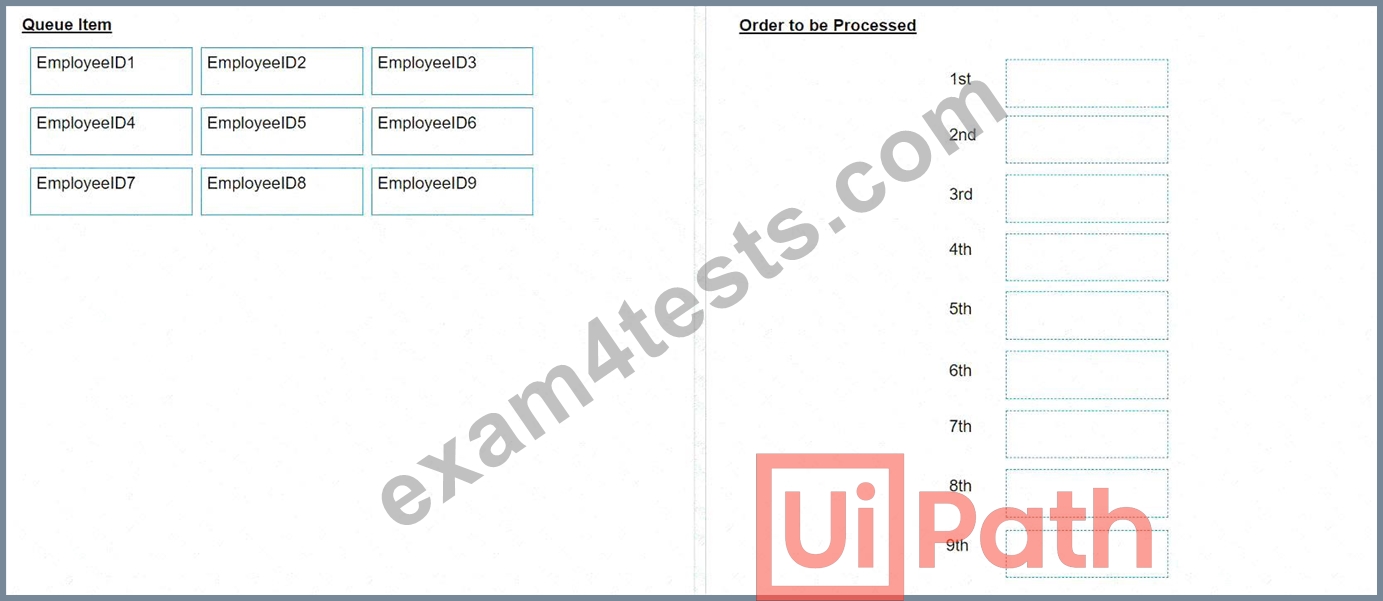
Answer:
Explanation:

NEW QUESTION # 62
To retrieve all Outlook emails with the word "UiPath" in the subject, which filtering property and filter schema should a developer use?
- A. Property: FilterByMessageIdsSchema: "@SQL=""urn:schemas:httpmail:subject'"' like 'UiPath%'"
- B. Property: FilterSchema: "@SQL=""urn:schemas:httpmail:subject"" like 'UiPath%'"
- C. Property: FilterSchema: "@SQL=""urn:schemas:httpmail:subject"" like '%UiPath%'"
- D. Property: FilterByMessageIdsSchema: "@SQL=""urn:schemas:httpmail:subject"" like '%UiPath%'"
Answer: C
Explanation:
o retrieve all Outlook emails with the word "UiPath" in the subject, the developer should use the Filter property and the filter schema "@SQL=""urn:schemas:httpmail:subject"" like '%UiPath%'". The Filter property allows the developer to specify a condition for retrieving the emails based on the email properties.
The filter schema is a string that follows the SQL syntax and uses the urn:schemas:httpmail namespace to access the email properties. The subject property is accessed by using "urn:schemas:httpmail:subject". The like operator is used to match the value of the subject property with a pattern that contains the word "UiPath".
The percent sign (%) is a wildcard that matches any sequence of characters. Therefore, the filter schema
"@SQL=""urn:schemas:httpmail:subject"" like '%UiPath%'" will match any email that has the word
"UiPath" anywhere in the subject. References: Get Outlook Mail Messages
NEW QUESTION # 63
Considering that the attached table is stored in a variable called "dt":
Which LINQ query can be used to return the maximum total Quantity?
- A. dt.AsEnumerable. OrderByDescending(Function(x) Convert.ToInt32(x("Quantity").ToString)). First.Item("Quantity")
- B. dt.AsEnumerable. Max(Function(x) Convert.ToInt32(x("Quantity").ToString))
- C. dt.AsEnumerable. Max(Function(x) Convert.ToInt32(x("Quantity").ToString))("Item")
- D. dt.AsEnumerable. GroupBy(Function(x) x("Item").ToString). Max(Function(x) x.Sum(Function(y) Convert.ToInt32(y("Quantity").ToString)))
Answer: D
NEW QUESTION # 64
What is the purpose of the Invoke Code activity in UiPath?
- A. Invokes VB MET or Java code optionally passing it a list of input arguments
- B. Invokes VB MET code optionally passing it a list of input arguments
- C. Invokes Java code, optionally passing it a list of input arguments.
- D. Invokes VB.NET or C# code, optionally passing il a list of input arguments.
Answer: D
Explanation:
The purpose of the Invoke Code activity in UiPath is to invoke VB.NET or C# code, optionally passing it a list of input arguments. The Invoke Code activity allows the developer to write and execute custom code in VB.NET or C# within a UiPath workflow. The Invoke Code activity has a Code property, where the developer can enter the code to be executed. The Invoke Code activity also has an Arguments property, where the developer can specify the input and output arguments for the code. The Invoke Code activity can be useful for performing complex calculations, manipulating data, or integrating with external libraries or applications that are not supported by the existing UiPath activities. References: [Invoke Code]
NEW QUESTION # 65
What is the correct sequence of steps in a REFramework project that is linked to Orchestrator it an application exception occurs on a Queue Item m the Process Transaction stale?
Instructions: Drag the Description found on the "Left" and drop on the correct Step Sequence found on the Right".
Answer:
Explanation:
Explanation:
NEW QUESTION # 66
On 10/04/2023 five Queue Items were added to a queue. What is the appropriate processing sequence for Queue Items based on their properties?
Instructions: Drag the Queue Item found on the " Left " and drop on the correct Process Sequence found on the " Right " .
Answer:
Explanation:
Explanation:
The processing sequence for queue items in UiPath Orchestrator is determined primarily by the deadline and priority of each item. Items with an earlier deadline are processed first. If multiple items have the same deadline, then priority determines the order: High, Normal, then Low.
Following this logic, the processing sequence would be:
1st: Deadline = 10/04/2023 Priority = LowSince this is the only item with the deadline of the current day (assuming today is 10/04/2023), it should be processed first regardless of its priority.
2nd: No deadline Priority = HighAlthough this item has no deadline, its high priority places it next in the sequence after items with a deadline for the current day.
3rd: Deadline = 10/05/2023 Priority = HighThis item is next due to its combination of an imminent deadline and high priority.
4th: Deadline = 10/05/2023 Priority = NormalThis item has the same deadline as the third but a lower priority, so it comes next.
5th: Deadline = 10/06/2023 Priority = HighThis item, while high priority, has the latest deadline, so it is processed last.
So the order would be:
1st: Deadline = 10/04/2023 Priority = Low2nd: No deadline Priority = High3rd: Deadline = 10/05/2023 Priority = High4th: Deadline = 10/05/2023 Priority = Normal5th: Deadline = 10/06/2023 Priority = High
NEW QUESTION # 67
Which activity Is specific tor Ul synchronization in UlPath Studio?
- A. Process Start Trigger
- B. Get Processes
- C. Use Applicationy/Browser
- D. Check App State
Answer: D
Explanation:
The Check App State activity is specifically designed for UI synchronization. It checks the state of a UI element, ensuring that subsequent actions are performed when the UI element is in the desired state.
NEW QUESTION # 68
Which of the following statements is true about the existing UiPath Studio installation packages?
- A. The Attended Robot installation package installs only the UiPath Robot.
- B. The Attended Robot installation package installs only UiPath Studio, and Robot.
- C. The Automation Developer installation package installs only UiPath Studio, Assistant, and Robot.
- D. The Unattended Robot installation package installs only UiPath Studio, Assistant, and Robot.
Answer: A
Explanation:
The statement that is true about the existing UiPath Studio installation packages is that the Attended Robot installation package installs only the UiPath Robot. The UiPath Robot is the component that executes the automation workflows designed in UiPath Studio. The Attended Robot installation package is intended for scenarios where the Robot works on the same machine as a human user and requires human input or supervision. The Attended Robot installation package does not include UiPath Studio or UiPath Assistant.
UiPath Studio is the component that allows the developer to design and debug the automation workflows.
UiPath Assistant is the component that allows the user to manage and run the automation workflows on their machine. The Unattended Robot installation package and the Automation Developer installation package both include UiPath Studio, UiPath Assistant, and UiPath Robot, but they are intended for different scenarios. The Unattended Robot installation package is for scenarios where the Robot works on a dedicated machine and does not require human input or supervision. The Automation Developer installation package is for scenarios where the developer needs to create and test the automation workflows on their machine. References: [UiPath Installation Guide], [UiPath Robot], [UiPath Studio], [UiPath Assistant]
NEW QUESTION # 69
Given the following workflow:
What will be the output of the Log Message activity?
- A. apple pear orange, mango kiwi
- B. apple, pear, orange
- C. "apple pear orange", "mango kiwi"
- D. apple, pear, orange, mango, kiwi
Answer: D
NEW QUESTION # 70
How does UiPath Integration Service benefit automation developers?
- A. By offering a comprehensive, unified platform dedicated solely to UI automation, enabling seamless integration with third-party applications.
- B. By substituting the requirement for API automation with UI automation capabilities, delivering a more manageable and user-friendly approach, allowing users to streamline their processes efficiently and effectively facilitating a more rapid integration process.
- C. By enabling developers to create custom UI elements for applications without using APIs.
- D. By standardizing authorization and authentication, managing API connections, and enabling faster integration into SaaS platforms.
Answer: D
Explanation:
UiPath Integration Service is a feature of UiPath Automation Cloud that allows you to connect to various external applications and systems using predefined connectors. A connector is a component that provides the logic and interface for interacting with a specific application or system. A connection is an instance of a connector that is configured with the credentials and parameters required to access the application or system.
UiPath Integration Service benefits automation developers by standardizing authorization and authentication, managing API connections, and enabling faster integration into SaaS platforms. By using UiPath Integration Service, automation developers can:
* Use a consistent and secure way of authenticating and authorizing access to different applications and systems, such as OAuth 2.0, API keys, or basic authentication.
* Manage and reuse connections across multiple automation projects, and share them with other developers using UiPath Orchestrator folders and permissions.
* Integrate with popular SaaS platforms, such as Microsoft Outlook 365, Salesforce, Google Sheets, and more, using the built-in connectors and activities that are available in UiPath Studio and other products.
* Trigger automations based on events or actions that occur in the external applications or systems, such as receiving an email, creating a record, or updating a spreadsheet.
* Build custom connectors for any system integration using the Connector Builder, which allows you to create and publish connectors based on third-party APIs.
The correct answer is B. By standardizing authorization and authentication, managing API connections, and enabling faster integration into SaaS platforms. This statement accurately describes how UiPath Integration Service benefits automation developers.
The other options are not correct statements. Option A is incorrect, because UiPath Integration Service does not substitute the requirement for API automation with UI automation capabilities, but rather combines them and allows both capabilities to be centrally accessed within the same integration design environment. Option C is incorrect, because UiPath Integration Service does not offer a comprehensive, unified platform dedicated solely to UI automation, but rather a component of the UiPath Platform that makes the automation of third- party applications easier by using both UI and API automation. Option D is incorrect, because UiPath Integration Service does not enable developers to create custom UI elements for applications without using APIs, but rather to create custom connectors for applications using APIs.
References: Integration Service - Introduction - UiPath Documentation Portal, New UiPath Integration Service | UiPath, Introducing UiPath Integration Service | UiPath Resources
NEW QUESTION # 71
Considering that the attached table is stored in a variable called "dt":
Which LINQ query can be used to return the maximum total Quantity?
- A. dt.AsEnumerable. OrderByDescending(Function(x) Convert.ToInt32(x("Quantity").ToString)).First.Item("Quantity")
- B. dt.AsEnumerable. Max(Function(x) Convert.ToInt32(x("Quantity").ToString))
- C. dt.AsEnumerable. Max(Function(x) Convert.ToInt32(x("Quantity").ToString))("Item")
- D. dt.AsEnumerable. GroupBy(Function(x) x("Item").ToString). Max(Function(x) x.Sum(Function(y) Convert.ToInt32(y("Quantity").ToString)))
Answer: D
Explanation:
The LINQ query that can be used to return the maximum total Quantity from the attached table is dt.AsEnumerable. GroupBy(Function(x) x("Item").ToString). Max(Function(x) x.Sum(Function(y) Convert.ToInt32(y("Quantity").ToString))). This query uses the LINQ methods AsEnumerable, GroupBy, Max, and Sum to manipulate the data in the dt variable. The dt variable is a DataTable that contains the following data:
No.
Item
Quantity
1
apple
10
2
orange
20
3
mango
50
4
kiwi
80
5
pear
1
6
apple
5
7
mango
15
The AsEnumerable method converts the DataTable into an Enumerable collection of DataRow objects. The GroupBy method groups the elements of the collection by the value of the Item column, creating a collection of groups. Each group has a key, which is the Item name, and a list of elements, which are the DataRows that have the same Item value. The Max method returns the maximum value of the collection, based on a selector function. The selector function is a lambda expression that calculates the sum of the Quantity column for each group. The Sum method returns the sum of the elements in a collection, based on a selector function. The selector function is a lambda expression that converts the value of the Quantity column into an integer.
Therefore, the query will group the DataRows by the Item name, calculate the total Quantity for each group, and return the maximum total Quantity among the groups. The maximum total Quantity is 80, which corresponds to the group with the key "kiwi". References: [DataTable.AsEnumerable Method],
[Enumerable.GroupBy Method], [Enumerable.Max Method], [Enumerable.Sum Method]
NEW QUESTION # 72
Which are the actions that can be done in Test Explorer?
- A. Export test data, group tests together, analyze activity coverage.
- B. Perform debugging, analyze activity coverage, group tests together.
- C. Export test results, group tests together, analyze activity coverage.
- D. Export test data, perform debugging, analyze activity coverage.
Answer: C
Explanation:
Test Explorer is a panel that shows information relevant to test automation in UiPath Studio. You can use Test Explorer and its sub-panels to perform various actions, such as1:
Export test results: You can export the test results shown in the Test Results panel to a JSON or HTML file, which can be used for further analysis or reporting.
Group tests together: You can group tests together based on different criteria, such as test type, test status, test suite, etc. This helps you organize and filter the tests in the Test Explorer panel.
Analyze activity coverage: You can analyze the activity coverage of your test cases by using the Activity Coverage panel, which shows the percentage of activities that have been executed during the test run. You can also filter the activities by covered or uncovered in the Designer panel.
The other options are not actions that can be done in Test Explorer, because they either involve features that are not part of Test Explorer, or they are not related to test automation. For example:
Option A is incorrect, because Test Explorer does not have a feature to export test data, but only test results. Test data can be generated or managed by using other activities, such as Generate Test Data or Test Data Queue.
Option B is incorrect, because Test Explorer does not have a feature to perform debugging, but only to run or retry tests. Debugging can be done by using the Debug tab in Studio, which allows you to set breakpoints, inspect variables, and step through the workflow.
Option D is incorrect, because Test Explorer does not have a feature to export test data, but only test results. Test data can be generated or managed by using other activities, such as Generate Test Data or Test Data Queue.
References:
1: Studio - Test Explorer - UiPath Documentation Portal
NEW QUESTION # 73
In order for a developer to utilize the default REFramework without relying on Orchestrator queues, what is the essential prerequisite to ensure that the project does not interact with Orchestrator?
- A. Omit the OrchestratorQueueName setting from the Config.xlsx file. Exclude the three SetTransactionStatus activities from the SetTransactionStatus workflow & change the variable type.
- B. Remove the Get Transaction Data state from the Main state machine. Remove the OrchestratorQueueName setting from Config.xlsx & change the variable type.
- C. Eliminate the Get Transaction Data state from the Main state machine. Exclude the Get Transaction Item activity from the project & change the variable type.
- D. Exclude the Get Transaction Item activity from the project. Eliminate the three SetTransactionStatus activities from the SetTransactionStatus workflow & change the variable type.
Answer: D
Explanation:
To utilize the default REFramework without relying on Orchestrator queues, the essential prerequisite is to exclude the Get Transaction Item activity from the project, eliminate the three SetTransactionStatus activities from the SetTransactionStatus workflow, and change the variable type of the TransactionItem and TransactionData variables. The Get Transaction Item activity is used to retrieve a transaction item from the Orchestrator queue, which is not needed if the queue is not used. The SetTransactionStatus activities are used to update the status of the transaction item in the Orchestrator queue, which is also not needed if the queue is not used. The variable type of the TransactionItem and TransactionData variables should be changed to match the type of data that is used as input for the process, such as DataRow, String, or Object. These changes will ensure that the project does not interact with Orchestrator and can use other sources of data for the transactions. References: [The UiPath REFrameWork], [Get Transaction Item], [Set Transaction Status]
NEW QUESTION # 74
......
UiPath UiPath-ADPv1 Exam Syllabus Topics:
| Topic | Details |
|---|---|
| Topic 1 |
|
| Topic 2 |
|
| Topic 3 |
|
| Topic 4 |
|
Prepare Important Exam with UiPath-ADPv1 Exam Dumps: https://torrentpdf.exam4tests.com/UiPath-ADPv1-pdf-braindumps.html