

Get Jan-2026 updated NSE7_SDW-7.2 Certification Exam Sample Questions
NSE7_SDW-7.2 Study Guide Cover to Cover as Literally
NEW QUESTION # 56
Refer to the exhibit.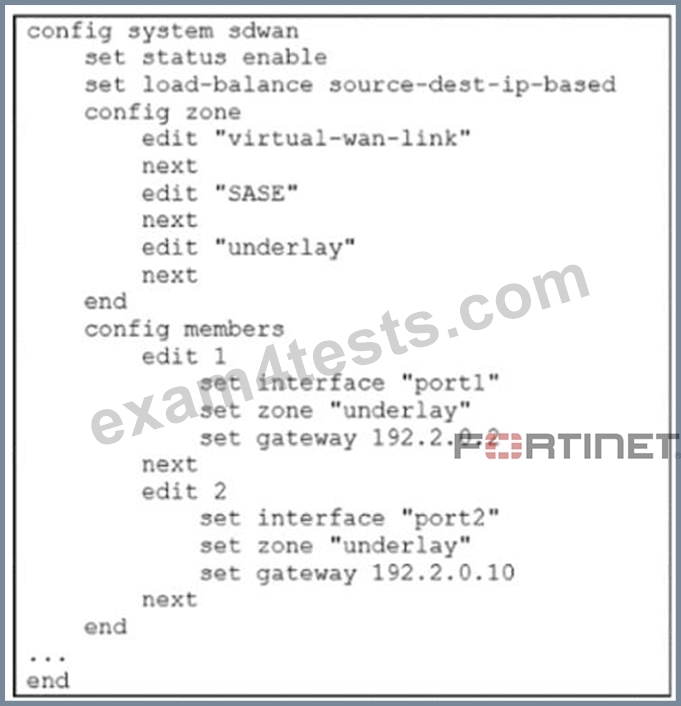
Which algorithm does SD-WAN use to distribute traffic that does not match any of the SD-WAN rules?
- A. All traffic from a source IP is sent to the same interface.
- B. All traffic from a source IP is sent to the most used interface.
- C. All traffic from a source IP to a destination IP is sent to the same interface.
- D. All traffic from a source IP to a destination IP is sent to the least used interface.
Answer: C
Explanation:
Study Guide 7.2, page 176.
NEW QUESTION # 57
Refer to the exhibit.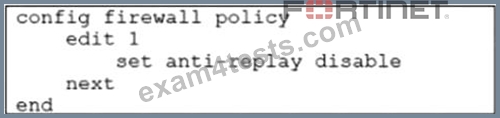
In a dual-hub hub-and-spoke SD-WAN deployment, which is a benefit of disabling the anti-replay setting on the hubs?
- A. It instructs the hub to disable the reordering of TCP packets on behalf of the receiver, to improve performance.
- B. It instructs the hub to not check the ESP sequence numbers on IPsec traffic, to improve performance.
- C. It instructs the hub to skip content inspection on TCP traffic, to improve performance.
- D. It instructs the hub to disable TCP sequence number check, which is required for TCP sessions originated from spokes to fail over back and forth between the hubs.
Answer: D
NEW QUESTION # 58
Refer to the exhibit.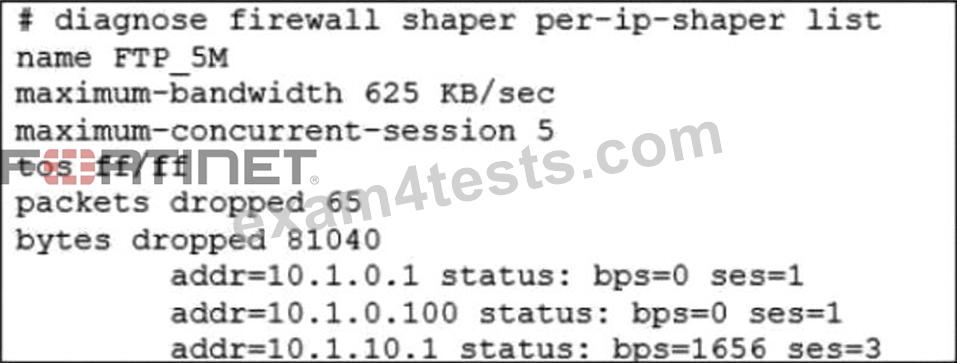
Which are two expected behaviors of the traffic that matches the traffic shaper? (Choose two.)
- A. The traffic shaper limits the combined bandwidth of all connections to a maximum of 5 MB/sec.
- B. The number of simultaneous connections among all source IP addresses cannot exceed five connections.
- C. The number of simultaneous connections allowed for each source IP address cannot exceed five connections.
- D. The traffic shaper limits the bandwidth of each source IP address to a maximum of 625 KB/sec.
Answer: C,D
NEW QUESTION # 59
Refer to the exhibits.
Exhibit A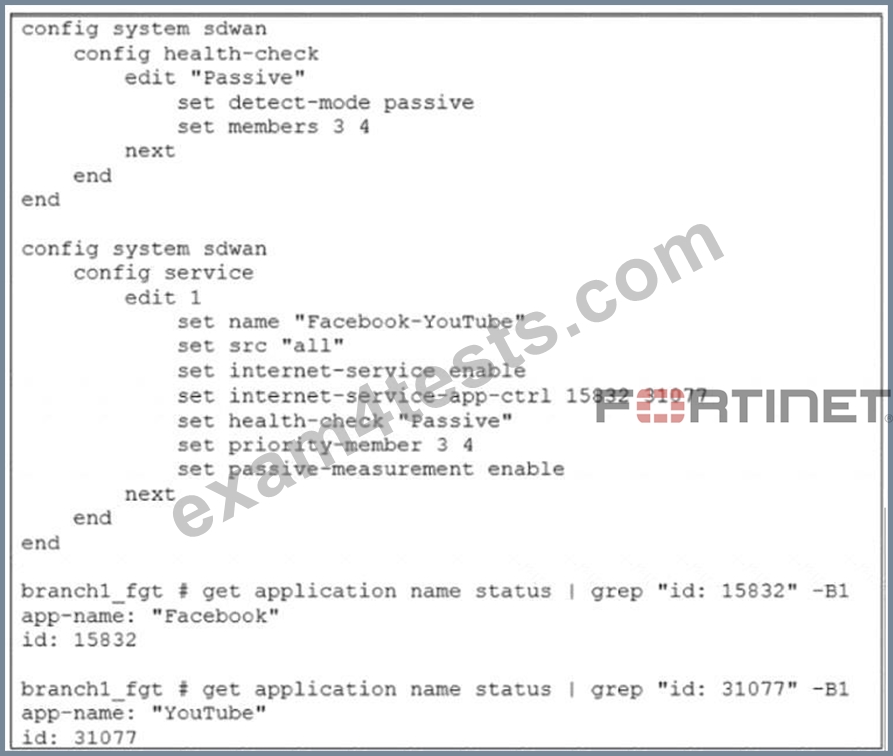
Exhibit B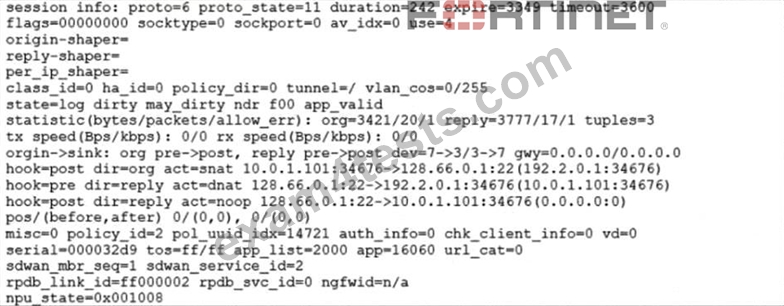
Exhibit A shows the SD-WAN performance SLA configuration, the SD-WAN rule configuration, and the application IDs of Facebook and YouTube. Exhibit B shows the firewall policy configuration and the underlay zone status.
Based on the exhibits, which two statements are correct about the health and performance of port1 and port2?
(Choose two.)
- A. FortiGate is unable to measure jitter and packet loss on Facebook and YouTube traffic.
- B. Non-TCP Facebook and YouTube traffic are not used for performance measurement.
- C. The performance is an average of the metrics measured for Facebook and YouTube traffic passing through the member.
- D. FortiGate identifies the member as dead when there is no Facebook and YouTube traffic passing through the member.
Answer: B,C
Explanation:
Study Guide 7.2, pages 103 - 104. Another comment said "because without using application Control on the firewall policy, SDWAN can't work" but there is a app control "default" defined on config.
NEW QUESTION # 60
Refer to the exhibit.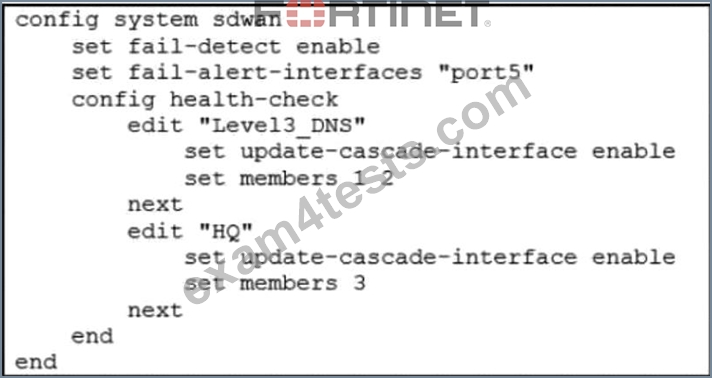
Based on the exhibit, which action does FortiGate take?
- A. FortiGate fails over to the secondary device after it detects all SD-WAN members as dead.
- B. FortiGate brings up port5 after it detects all SD-WAN members as alive.
- C. FortiGate bounces port5 after it detects all SD-WAN members as dead.
- D. FortiGate brings down port5 after it detects all SD-WAN members as dead.
Answer: A
NEW QUESTION # 61
Refer to the exhibit.
The device exchanges routes using IBGP.
Which two statements are correct about the IBGP configuration and routing information on the device?
(Choose two.)
- A. Each BGP route is three hops away from the destination.
- B. ibgp-multipath is disabled.
- C. You can run the get router info routing-table database command to display the additional paths.
- D. additional-path is enabled.
Answer: C,D
NEW QUESTION # 62
Refer to the exhibits.
Exhibit A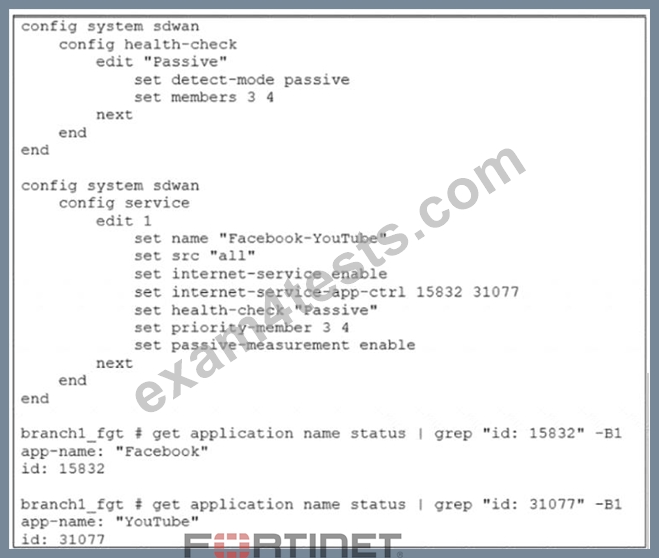
Exhibit B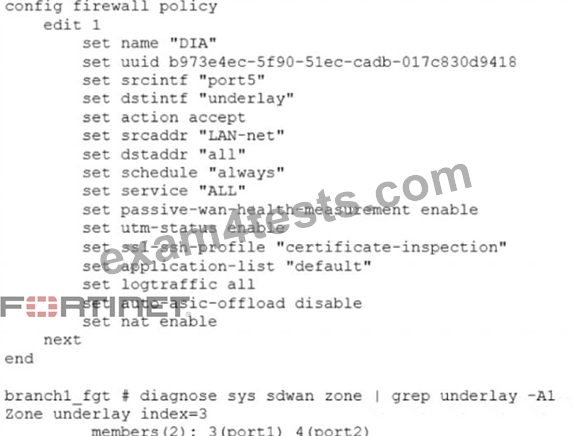
Exhibit A shows the SD-WAN performance SLA configuration, the SD-WAN rule configuration, and the application IDs of Facebook and YouTube. Exhibit B shows the firewall policy configuration and the underlay zone status.
Based on the exhibits, which two statements are correct about the health and performance of port1 and port2?
(Choose two.)
- A. FortiGate is unable to measure jitter and packet loss on Facebook and YouTube traffic.
- B. Non-TCP Facebook and YouTube traffic are not used for performance measurement.
- C. The performance is an average of the metrics measured for Facebook and YouTube traffic passing through the member.
- D. FortiGate identifies the member as dead when there is no Facebook and YouTube traffic passing through the member.
Answer: B,C
Explanation:
Study Guide 7.2, pages 103 - 104. Another comment said "because without using application Control on the firewall policy, SDWAN can't work" but there is a app control "default" defined on config.
NEW QUESTION # 63
Refer to the exhibit.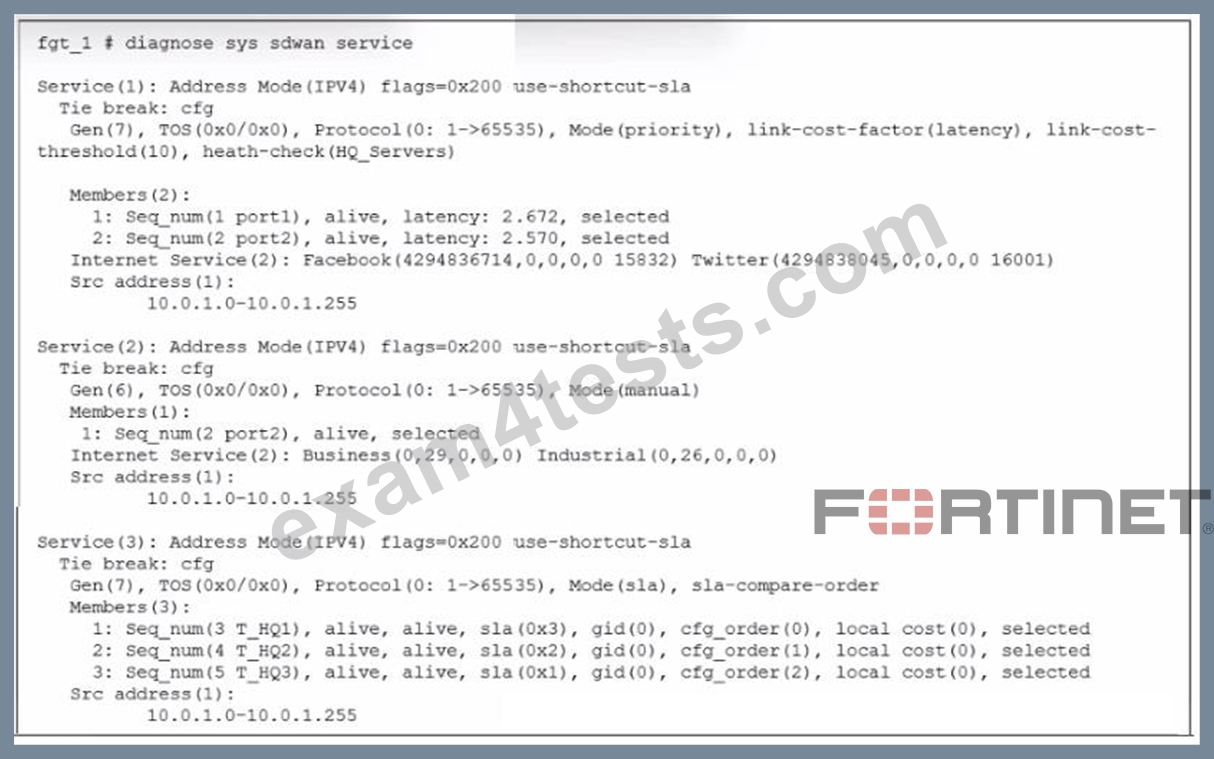
The exhibit shows output of the command diagnose 3vg sdwan service collected on a FortiGate device.
The administrator wants to know through which interface FortiGate will steer the traffic from local users on subnet 10.0.1.0/255.255.255.192 and with a destination of the business application Salesforce located on HO servers 10.0.0.1.
Based on the exhibits, which two statements are correct? (Choose two.)
- A. There is no service defined for the Salesforce application, so FortiGate will use the service rule 3 and steer the traffic through interface T_HQ1.
- B. When FortiGate cannot recognize the application of the flow it steers the traffic destined to server
10.0.0.1 according to service rule 3. - C. FortiGate steers traffic to HO servers according to service rule 1 and it uses port1 or port2 because both interfaces are selected.
- D. FortiGate steers traffic for business application according to service rule 2 and steers traffic through port2.
Answer: B,C
NEW QUESTION # 64
Refer to the exhibit.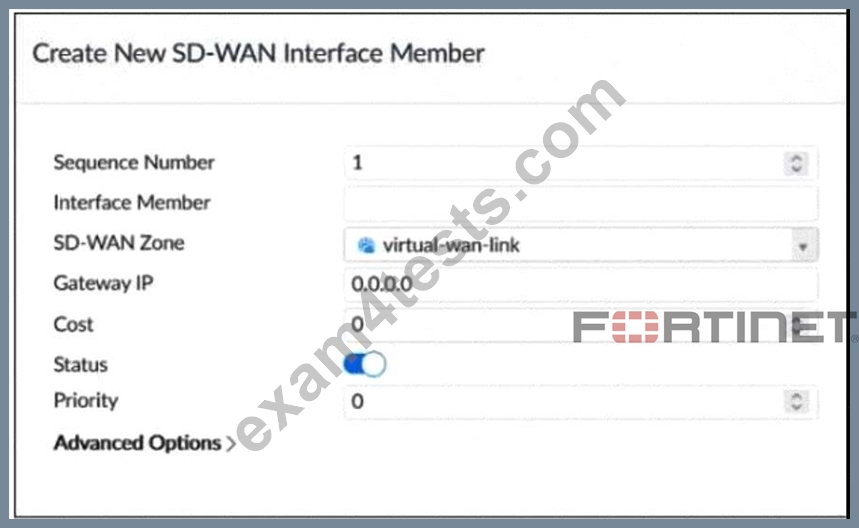
Which two SD-WAN template member settings support the use of FortiManager meta fields? (Choose two.)
- A. Gateway IP
- B. Priority
- C. Interface member
- D. Cost
Answer: A,C
NEW QUESTION # 65 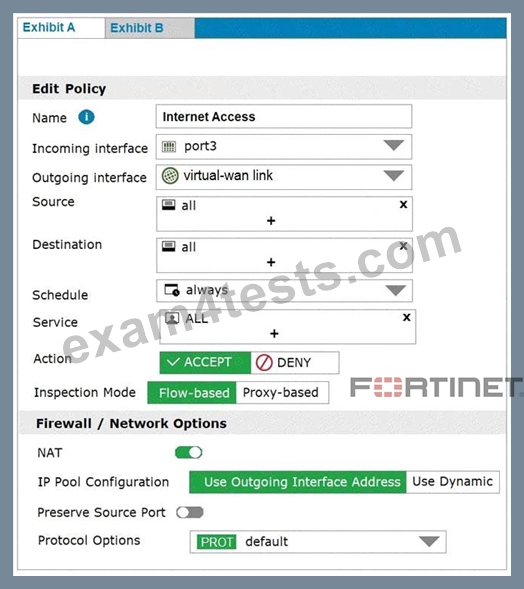
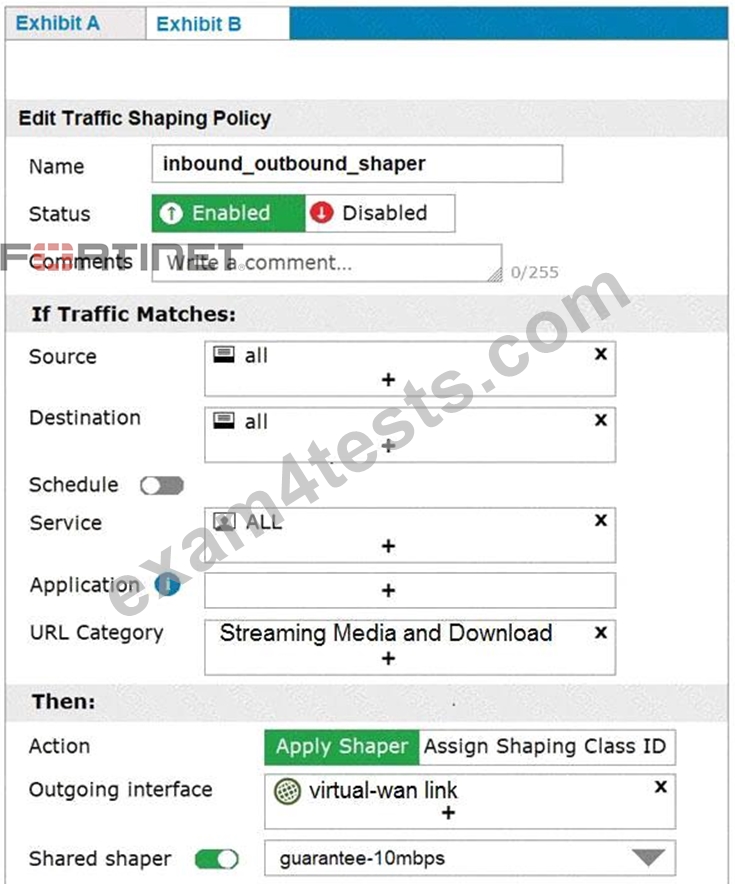
Exhibit A shows the firewall policy and exhibit B shows the traffic shaping policy.
The traffic shaping policy is being applied to all outbound traffic; however, inbound traffic is not being evaluated by the shaping policy.
Based on the exhibits, what configuration change must be made in which policy so that traffic shaping can be applied to inbound traffic?
- A. In the traffic shaping policy, select Assign Shaping Class ID as Action.
- B. Create a new firewall policy, and the select the SD-WAN zone as Incoming Interface.
- C. In the firewall policy, select Proxy-based as Inspection Mode.
- D. In the traffic shaping policy, enable Reverse shaper, and then select the traffic shaper to use.
Answer: D
NEW QUESTION # 66
Refer to the exhibit.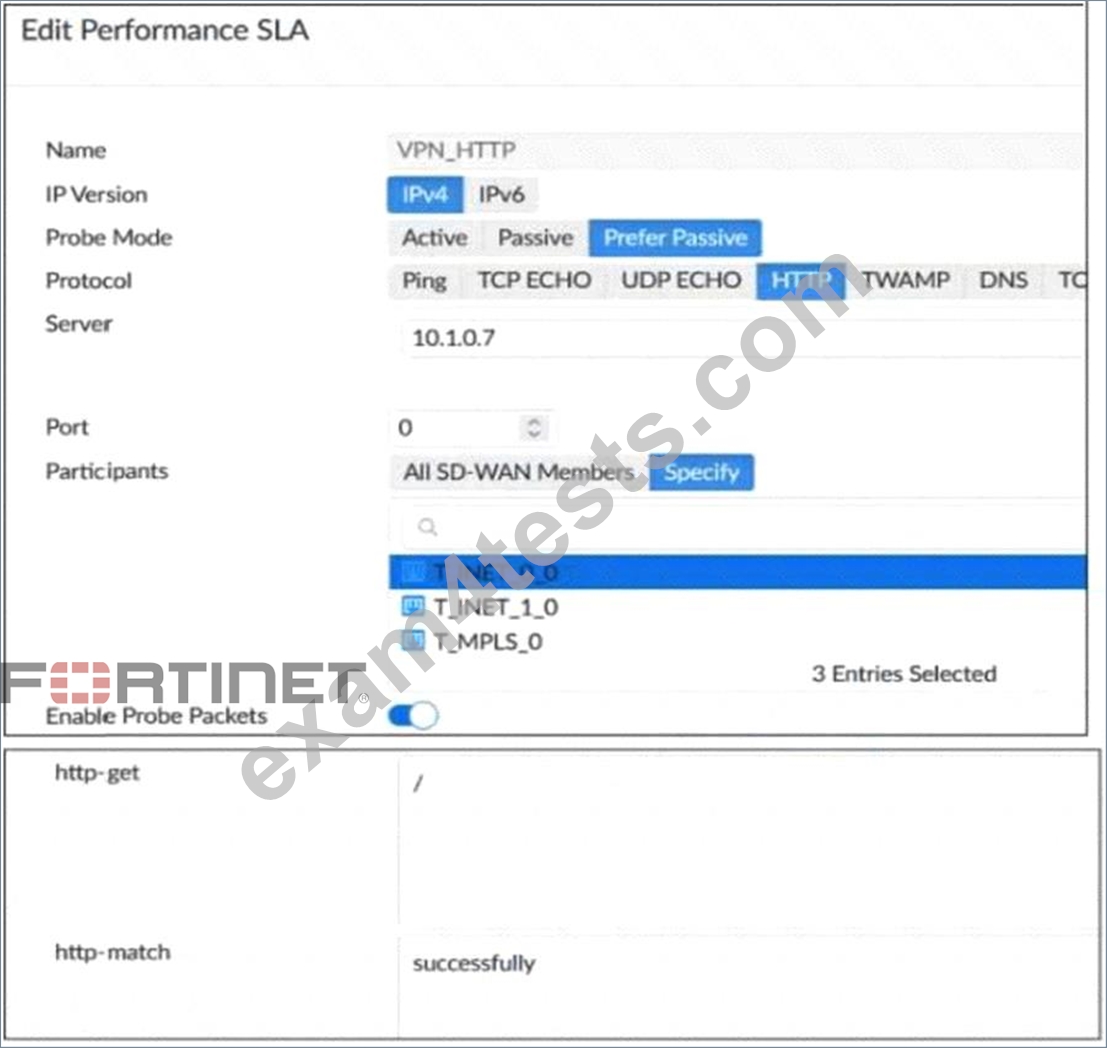
Based on the exhibit, which two statements are correct about the health of the selected members? (Choose
two.)
- A. After FortiGate switches to active mode, FortiGate never fails back to passive monitoring.
- B. FortiGate passively monitors the member if TCP traffic is passing through the member.
- C. FortiGate can offload the traffic that is subject to passive monitoring to hardware.
- D. During passive monitoring, FortiGate can't detect dead members.
Answer: B,D
NEW QUESTION # 67
Refer to the exhibits.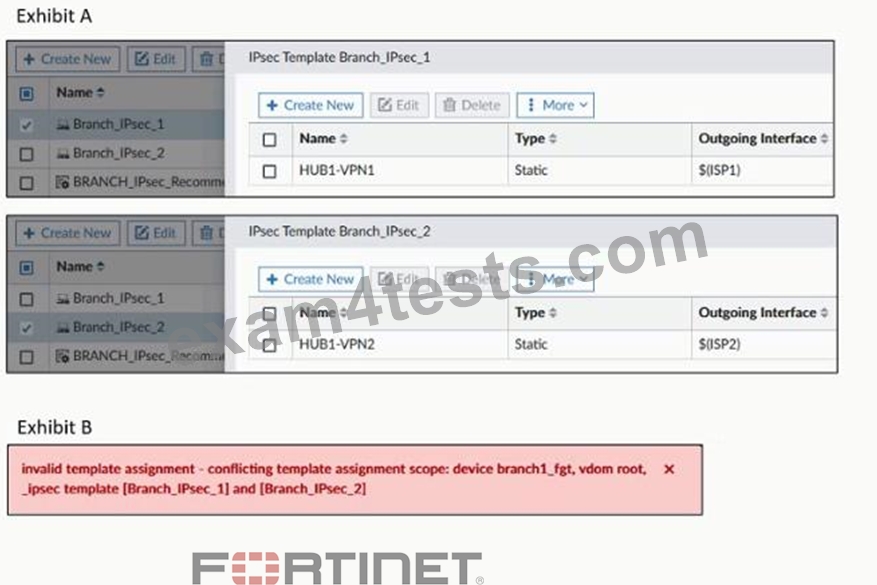
Exhibit A shows two IPsec templates to define Branch_IPsec_1 and Branch_IPsec_2. Each template defines a VPN tunnel.
Exhibit B shows the error message that FortiManager displayed when the administrator tried to assign the second template to the FortiGate device.
Which statement best explain the cause for this issue?
- A. You should review the branch1_fgt configuration for the already configured tunnel with the name HUB1-VPN2.
- B. You can assign only one IPsec template to each FortiGate device.
- C. You can define only one IPsec tunnel from branch devices to HUB1.
- D. You can assign only one template with a tunnel of fype static to each FortiGate device
Answer: B
Explanation:
The error message in Exhibit B indicates a conflicting template assignment. This occurs because FortiManager does not allow the assignment of multiple IPsec templates that define VPN tunnels with the same name or settings to the same FortiGate device. The conflict arises from trying to assign a second IPsec template to a device that already has one assigned. Reference: This is based on Fortinet's best practices and administrative guidelines which state that each FortiGate device should be assigned a unique IPsec template to avoid configuration conflicts.
NEW QUESTION # 68
Refer to the exhibit.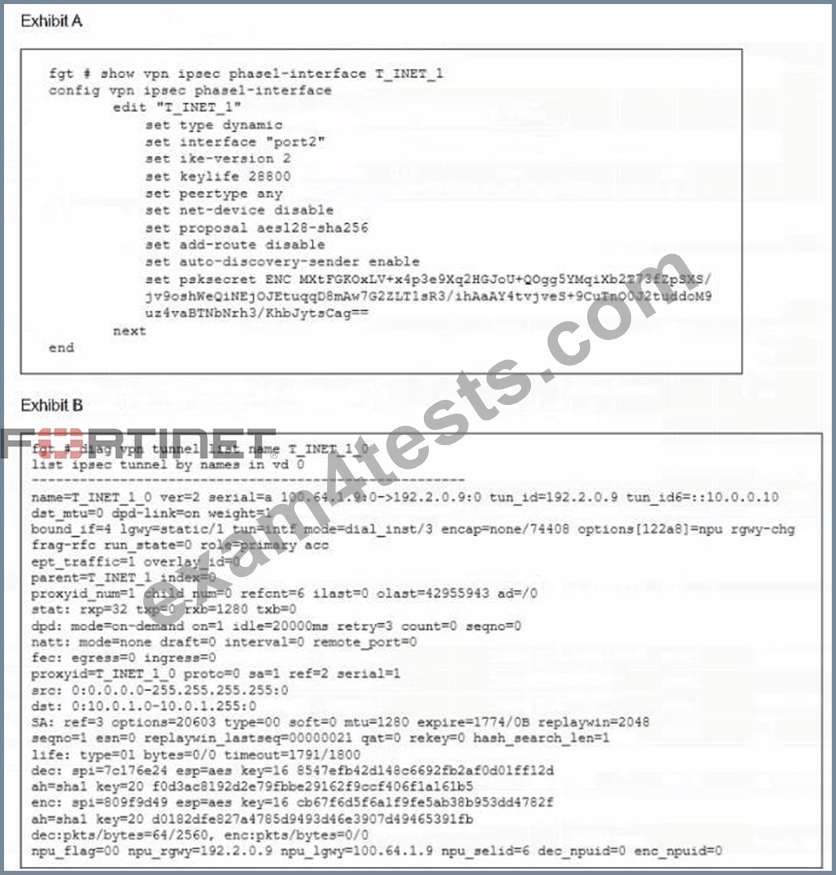
Which two statements about the IPsec VPN configuration and the status of the IPsec VPN tunnel are true?
(Choose two.)
- A. FortiGate facilitated the negotiation of the T_INET_1_0_0 ADVPN shortcut over T_INET_1_0.
- B. Dead peer detection is disabled.
- C. FortiGate does not install IPsec static routes for remote protected networks in the routing table.
- D. The phase 1 configuration supports the network-overlay setting.
Answer: C,D
NEW QUESTION # 69
Which statement about SD-WAN zones is true?
- A. An SD-WAN zone can contain only one type of interface.
- B. You cannot use an SD-WAN zone in static route definitions.
- C. An SD-WAN zone can contain between 0 and 512 members.
- D. You can configure up to 32 SD-WAN zones per VDOM.
Answer: C
Explanation:
Full Explanation:
* Option Ais incorrect because SD-WAN zones can include multiple interface types (e.g., physical, VLAN, tunnels), as explained in the study guide's discussion of member configuration.
* Option Bis correct because an SD-WAN zone can logically have zero members (an empty zone) and up to a large number of members, with 512 being a reasonable upper bound supported by Fortinet's scalability, even if not explicitly stated in the study guide.
* Option Cis incorrect because the study guide clearly states that SD-WAN zones can be used in static route definitions, enhancing routing flexibility.
* Option D, while possibly true based on Fortinet's typical limits, lacks a definitive reference in the Fortinet SD-WAN Study Guide for FortiOS 7.2to confirm "32" as the exact number, making it less certain than Option B.
References:
* Fortinet SD-WAN Study Guide for FortiOS 7.2, Section 3: Members, Zones, and Performance SLAs (description of interface types and zones).
* Fortinet SD-WAN Study Guide for FortiOS 7.2, Section 4: Routing and Sessions (use of SD-WAN zones in static routes).
* Fortinet Documentation:SD-WAN members and zones | FortiGate / FortiOS 7.2.4(general behavior and flexibility of zones).
NEW QUESTION # 70
What are two benefits of choosing packet duplication over FEC for data loss correction on noisy links? (Choose two.)
- A. Packet duplication can leverage multiple IPsec overlays for sending additional data.
- B. Packet duplication uses smaller parity packets which results in less bandwidth consumption.
- C. Packet duplication does not require a route to the destination.
- D. Packet duplication supports hardware offloading.
Answer: A,D
NEW QUESTION # 71
Refer to the exhibits.
Exhibit A -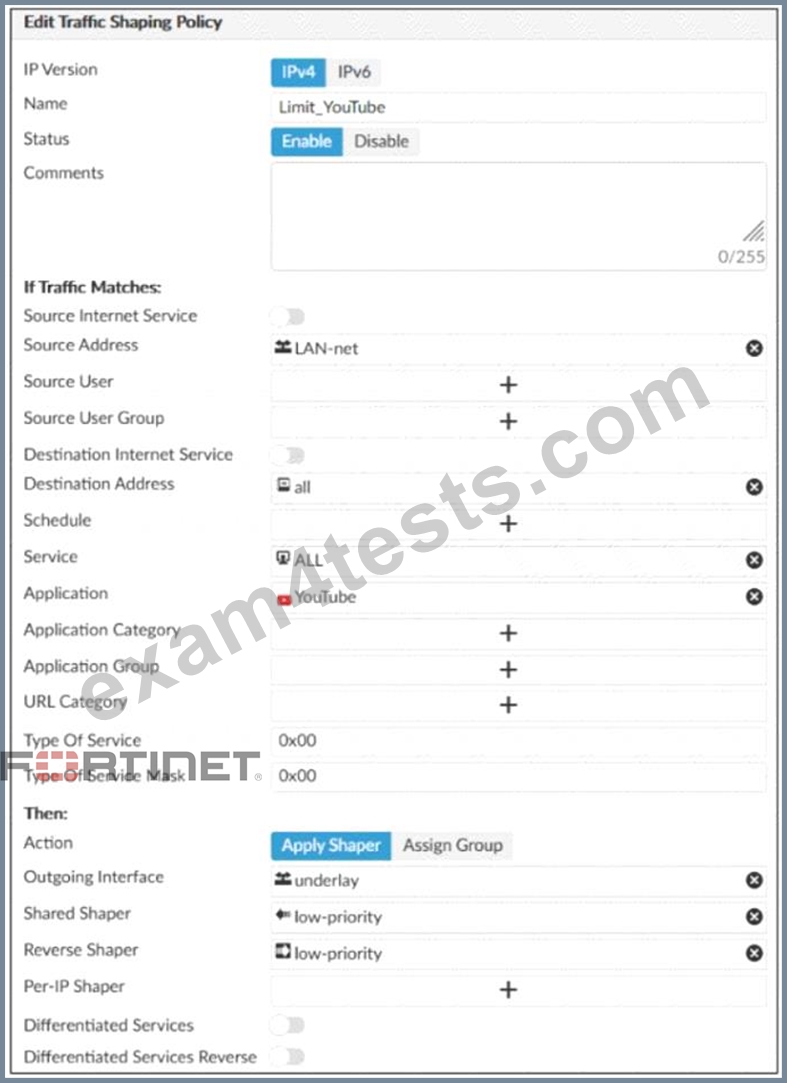
Exhibit B -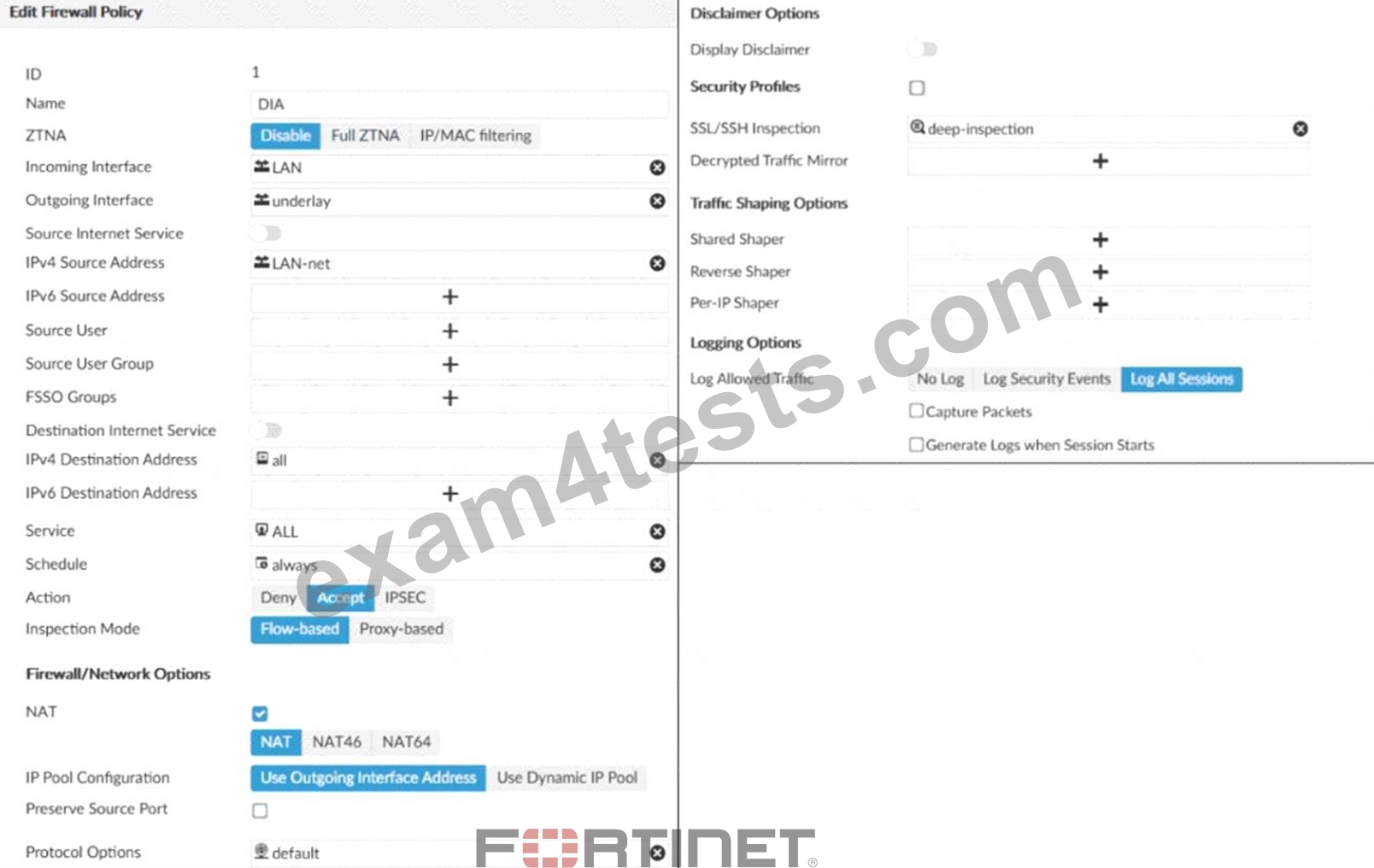
Exhibit A shows the traffic shaping policy and exhibit B shows the firewall policy.
The administrator wants FortiGate to limit the bandwidth used by YouTube. When testing, the administrator determines that FortiGate does not apply traffic shaping on YouTube traffic.
Based on the policies shown in the exhibits, what configuration change must be made so FortiGate performs traffic shaping on YouTube traffic?
- A. Application control must be enabled on the firewall policy.
- B. Individual SD-WAN members must be selected as the outgoing interface on the traffic shaping policy.
- C. Web filtering must be enabled on the firewall policy.
- D. Destination internet service must be enabled on the traffic shaping policy.
Answer: C
NEW QUESTION # 72
Refer to the exhibit, which shows the IPsec phase 1 configuration of a spoke.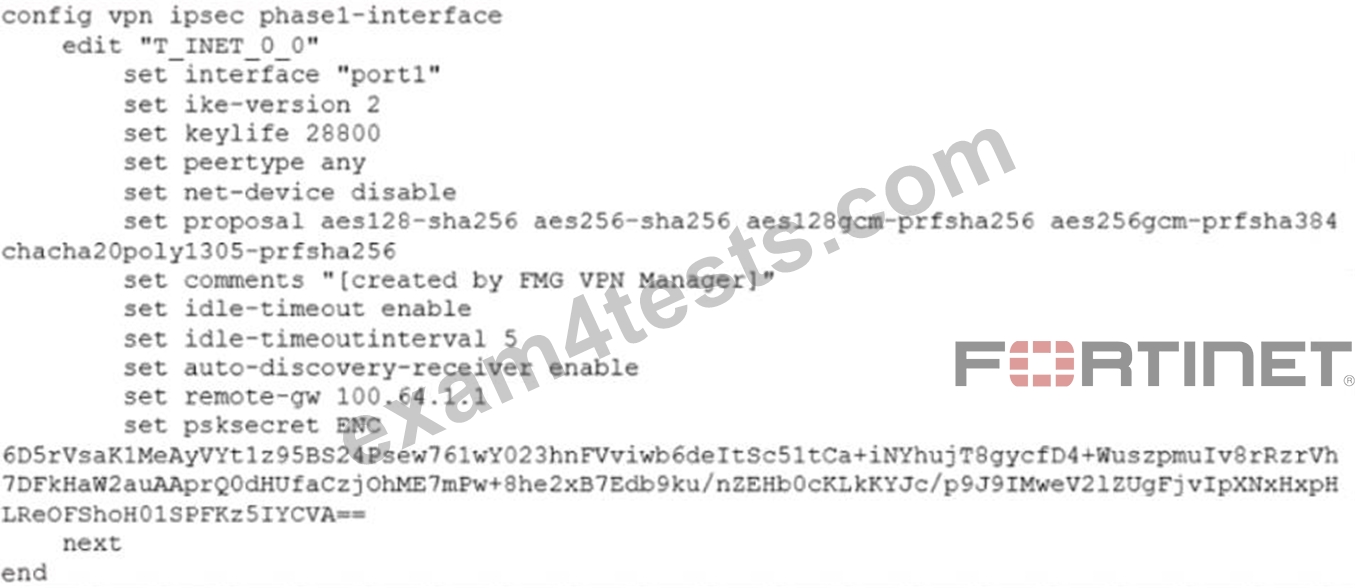
What must you configure on the IPsec phase 1 configuration for ADVPN to work with SD-WAN?
- A. You must set ike-version to 1.
- B. You must disable idle-timeout.
- C. You must enable net-device.
- D. You must enable auto-discovery-sender.
Answer: C
NEW QUESTION # 73
......
100% Real & Accurate NSE7_SDW-7.2 Questions and Answers with Free and Fast Updates: https://torrentpdf.exam4tests.com/NSE7_SDW-7.2-pdf-braindumps.html